

Iron Powder for Diamond Segments: Fix Dull, Glazing Blades
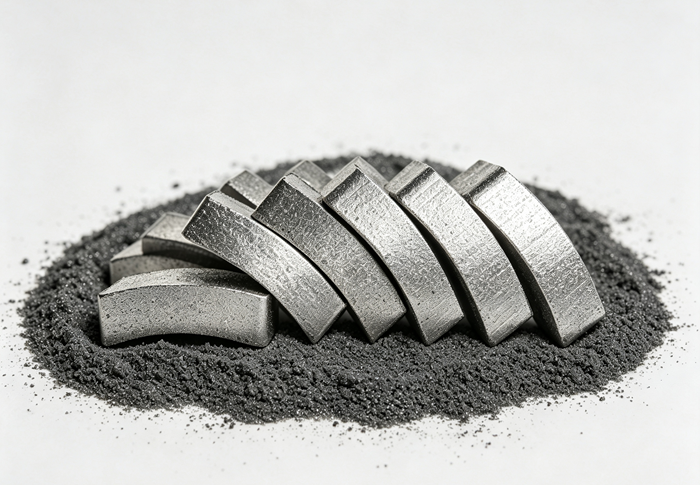
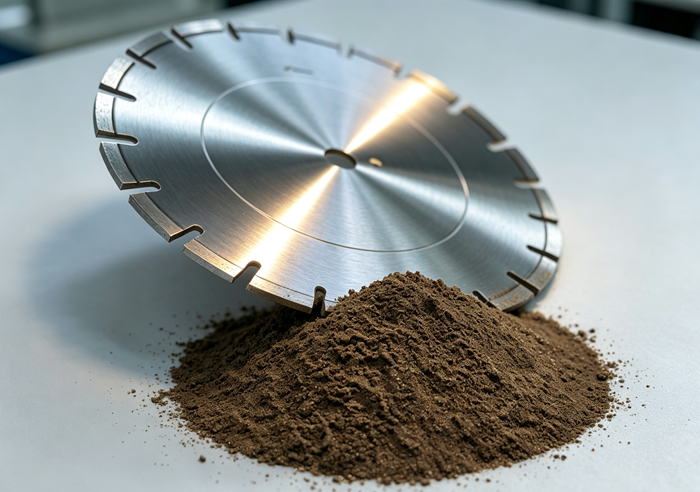
Choosing the right Iron Powder for diamond segments is usually the fastest way to improve sharpness — faster than changing the diamond, and far cheaper than switching to a cobalt-heavy bond. The mechanism is simple to state and hard to execute: a segment stays sharp only when the bond matrix wears slightly faster than the diamonds, so dull grits release and fresh edges are exposed. Get that ratio right and the segment keeps biting. Get it wrong and you get a glazed, polished, useless rim.
Most toolmakers come to us with the same problem, framed the same way: "The segment lasts, but it doesn't cut." They are right to care. In granite and concrete sawing, feed rate and ampere draw decide whether a machine pays for itself. A segment that holds its dimension while the saw stalls isn't a durable segment — it's an expensive brake.
In this guide: the self-sharpening mechanism, an element-by-element function table, particle size selection, sintering windows, cobalt replacement under REACH, and the mistakes that destroy sharpness.
Key Takeaways
- Sharpness is self-sharpening. The bond must wear marginally faster than the diamonds; a too-wear-resistant bond glazes and stops cutting.
- Ultra-fine iron powder (typically D50 3–10 µm)raises sintered density and diamond retention, and can partially replace Copper to cut formulation cost.
- Elements have direction: Fe pushes toward sharpness, Ni/W/WC push toward life, Cu and Co are neutral levers. Add more of any one of them without a plan, and you'll move the wrong metric.
- There is a real trade-off. In field experience, a sharpness gain of roughly 85–95% typically retains 70–90% of baseline life. You can't max both by tweaking ratios — you change the system.
- Cobalt replacement is now compliance-driven as much as cost-driven: cobalt metal carries a harmonized CLP classification as Carcinogenic Category 1B, and several cobalt salts are listed on the EU REACH Candidate List as SVHCs. Iron-based and Fe-Cu-Sn pre-alloyed bonds are now a strategic choice for European buyers.
Why Sharpness Starts with the Bond Matrix, Not Just the Diamond
Diamonds are the cutting edge, but the bond decides whether that edge ever reaches the work. A diamond that never protrudes can't cut; a diamond that falls out early cuts once and is gone.
The matrix does three jobs:
- Retention — hold each grit until it is genuinely dull.
- Wear rate — recede at a controlled pace so new grits keep exposing.
- Heat and chip management — survive the thermal load at the face without softening or glazing.
A segment failing at #1 sheds diamonds wholesale. One failing at #2 glazes and stalls. Both look like bad diamonds. Neither usually is.
The Self-Sharpening Principle: Balancing Matrix Wear vs Diamond Wear
Self-sharpening is the ability of a diamond segment to expose fresh diamond as worn grits release; it depends on the bond matrix wearing slightly faster than the diamonds. In practice, that means one ratio:
Matrix wear rate ÷ Diamond wear rate
- Well below 1 (bond far too wear-resistant): dull diamonds sit proud, the face polishes flat, feed rate collapses — the classic glazed segment.
- Well above 1 (bond too soft): diamonds release before they dull. Initial sharpness feels great, life falls off a cliff, cut face is rough.
- Slightly above 1: dull grits release, new grits expose, cutting rhythm holds steady.
Sharpness is not the same as softness — a hard bond with the right microstructure can out-cut a soft bond with a badly distributed one. And more uncomfortably for buyers: sharpness and life genuinely compete in most systems.
Based on our work across granite, marble, ceramic and concrete jobs, a workable starting expectation:
| Target | Sharpness gain vs. baseline | Life retained |
| Aggressive, high-throughput | ~85–95% | ~70–90% |
| Balanced production | ~40–60% | ~85–95% |
| Life-first (specialty, dry cutting) | ~10–25% | ~100–120% |
All figures are empirical ranges from field trials, not guaranteed specifications. Actual results depend on stone hardness, machine power, coolant supply, diamond grade and operator technique. Always validate on your own machine.
Note the third row: life-first is a legitimate choice, but it costs feed rate. It should be a decision, not an accident.
Want to see this trade-off on your own machine? Request free powder samples for a side-by-side test →
Choosing the Right Powder: Iron-based vs Fe-Co-Cu vs Fe-Cu-Ni
Three bond families dominate modern tooling. They differ less in raw strength than in wear behavior — which is what actually controls sharpness.
| Bond system | Typical composition | Sharpness | Life | Cost | Best suited to |
| Iron-based (Fe-Cu-Sn) | Fe 60–75%, Cu 15–25%, Sn 3–8%, optional P | High | Medium | Low | Granite, concrete, asphalt |
| Fe-Co-Cu | Fe 40–55%, Co 20–35%, Cu 15–25% | Medium | Very high | High, volatile | Premium granite, hard stone, dry cutting |
| Fe-Cu-Ni | Fe 50–65%, Cu 20–28%, Ni 8–15%, Sn 3–6% | Medium | High | Medium | Marble, ceramic, medium-hard stone |
Compositions are indicative ranges, not fixed recipes. Final ratios must be tuned to diamond size, concentration, sintering equipment and application.
The shift shows up in our own orders: iron-based systems reinforced with ultra-fine iron and pre-alloyed powders, replacing part of the cobalt in conventional Fe-Co-Cu bonds.
Element-by-Element: What Each Addition Does to Sharpness
Most unstable formulations come from adding elements without knowing what each does during sintering.
| Element | Mechanism | Effect on sharpness | Typical addition (empirical) |
| Fe | Matrix skeleton; mechanical interlock with diamond | Higher Fe → faster matrix wear → sharpness up | 45–75% |
| Cu | Lowers melting point, increases liquid volume, improves density | Moderate improves retention; excess makes the bond too ductile → down | 15–28% |
| Sn | Low-melting phase with Cu; improves wetting and diffusion | Improves density and consistency of grit exposure | 3–8% |
| P | Forms Fe-P / Cu-P phosphides; activates sintering | Raises density and retention; excess increases brittleness | 0.5–3% |
| Ni | Solid-solution strengthening | Wear resistance up → sharpness down (a life element) | 5–15% |
| W / WC | Hard phase dispersed in the matrix | Raises wear resistance; excess → over-hard bond → severe glazing | 3–15% (WC ≤10%) |
| Co | Excellent diamond wettability; strongest retention | Strong life gain; neutral-to-conservative on sharpness | 15–35% |
| Zn | Forms brass phase with Cu, improves low-melt flow | Improves uniformity, reduces segregation | 2–6% |
Read this as a set of directions. Fe moves you toward sharpness. Ni, W and WC move you toward life. Cu and Co are neutral levers. Decide which direction you need before you touch any ratio. For how these choices play out at different bond hardness levels, see bond hardness vs sharpness trade-off.
Ultra-fine Iron Powder: Sharper Segments at Lower Cost
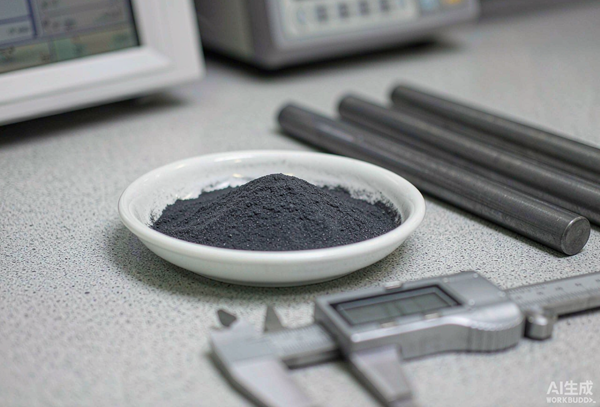
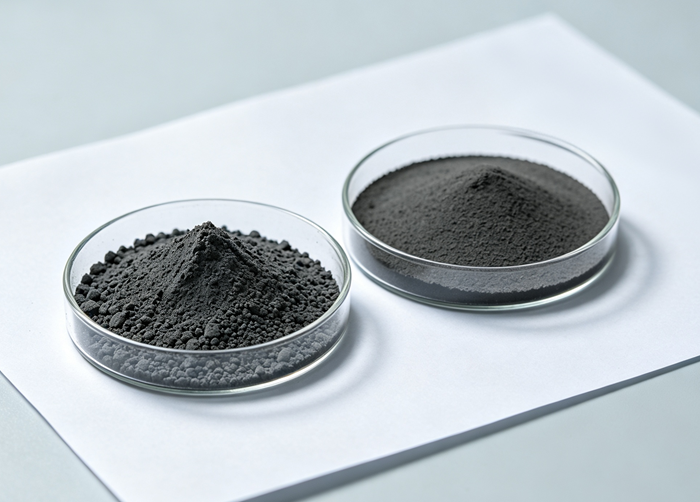
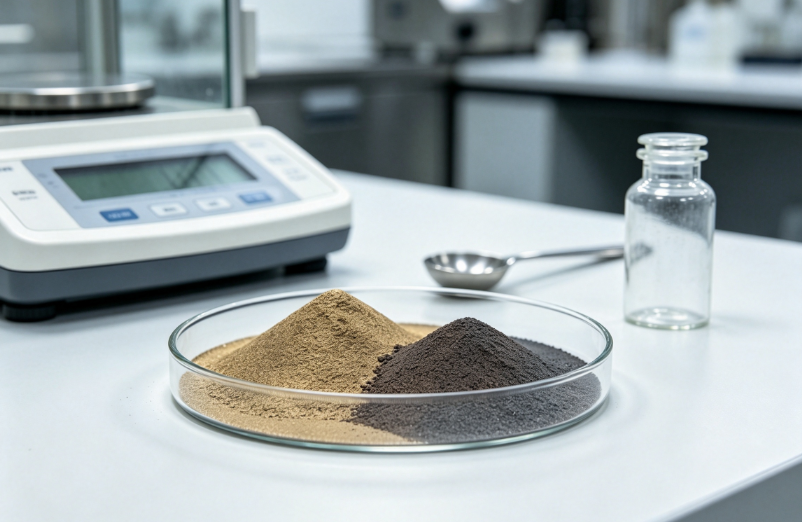
Ultra-fine iron powder is iron powder with a median particle size (D50) between roughly 3 and 10 µm; its high specific surface area raises sintering activity, which is what makes denser, more uniformly wearing bonds possible. Conventional reduced iron powder commonly sits at D50 40–100 µm. Reducing particle size triggers three linked effects:
- Much higher specific surface area → greater sintering driving force, more complete diffusion at the same temperature.
- Denser, more uniform sintered structure → lower porosity, more consistent retention, no patchy diamond loss.
- More uniform wear → the working face recedes evenly, exposing diamonds layer by layer instead of failing locally.
These mechanisms are consistent with published work on fine iron powder sintering and Fe-based bond wetting in journals such as the International Journal of Refractory Metals & Hard Materials and Diamond and Related Materials.
Ultra-fine iron powder does not make the bond softer — it makes the wear pattern more orderly. That is why it can improve sharpness and consistency at once, which sounds contradictory until you look at the microstructure. Storing fine powders is a discipline of its own.
Because ultra-fine iron sinters so actively, it can also partially replace copper powder while maintaining density. Copper is consistently the more expensive component, so for high-volume producers that substitution is a straightforward margin gain.
Curious how much copper your recipe could give up? Send us your formulation for a free powder selection review →
Cobalt Replacement: Performance Plus REACH Compliance
Cobalt has long been the default answer for retention, and Fe-Co-Cu bonds hold diamonds exceptionally well. But cobalt now carries two costs, and the second is growing faster than the first.
The first cost is obvious: cobalt pricing is volatile, driven by supply concentration and battery-market demand. Formulations with 20–35% cobalt are directly exposed, and quoting long-term contracts on such a recipe is uncomfortable.
The second cost is regulatory: cobalt metal carries a harmonized CLP classification as Carcinogenic Category 1B (Muta. 2, Repr. 1B), and several cobalt salts — cobalt sulfate, dichloride, dinitrate, carbonate and diacetate — are listed on the EU REACH Candidate List as Substances of Very High Concern (SVHC) (ECHA Candidate List). Cobalt metal itself is not automatically an SVHC; it is under substance evaluation in ECHA's CoRAP program, and the Cobalt Institute maintains a plain-language Q&A on the cobalt metal classification (CLP 14th ATP). For articles containing those listed salts above 0.1% w/w, Article 33 supply-chain communication obligations apply. Customers' own substance-restriction programs kick in on top. For European and UK toolmakers this is not theoretical — procurement teams increasingly ask suppliers to document cobalt content and to offer reduced-cobalt or cobalt-free alternatives (replacing cobalt in Fe-Co-Cu diamond bonds).
The practical response is iron-based and Fe-Cu-Sn pre-alloyed bonds, supported by ultra-fine iron powder and controlled additions of P, Sn and Zn to recover the wetting and density cobalt used to provide.
| Aspect | Shift observed |
| Sharpness | Neutral to improved (iron-based bonds wear faster and self-sharpen more readily) |
| Life | Reduced, typically 10–25% |
| Formulation cost | Meaningfully lower, with more stable input pricing |
| Documentation burden | Simplified; SVHC communication obligations fall away where listed cobalt salts are no longer present above 0.1% w/w |
| Best fit | Granite, concrete and asphalt cutting where throughput matters more than maximum life |
That is why we treat cobalt replacement as a strategic move rather than a price play: it removes a compliance exposure, stabilizes input cost, and in many cutting applications it improves the metric customers complain about most. It is not right for every premium dry-cutting job — and we will tell you when it isn't.
Matching the Bond Matrix to Your Application
Which bond powder for which material? Start here: all addition levels and temperature windows below are empirical — validate against your own press and stone.
| Cutting application | Recommended system | Addition guidance | Sintering window | Notes |
| Granite | Iron-based + ultra-fine iron, or Fe-Cu-Co-Sn | Ultra-fine iron 20–40% of metal powder; SCF-10 at 10–25% | 820–870 °C | Hard stone demands strong self-sharpening; use WC sparingly |
| Marble | Fe-Cu-Ni + ultra-fine iron | Ultra-fine iron 15–30%; Ni 8–12% | 780–840 °C | Sharpness rarely the constraint; control wear and edge quality |
| Ceramic / tile | Fine-particle Fe-Cu-Ni with fine diamond | Ultra-fine iron 20–35%; WC ≤8% | 800–860 °C | Prioritize clean edges and low chipping; bond must not be too soft |
| Concrete / asphalt | Iron-based + SCF-10 / S2386 | SCF-10 at 15–30%; Sn raised to 5–8% | 810–860 °C | High impact loading; coated diamond further improves retention |
Sintering Notes: Temperature, Time and Atmosphere Windows
Sintering is where good powder becomes a good segment, or doesn't.
| Parameter | Typical range | Effect on sharpness |
| Sintering temperature | 780–880 °C (system dependent) | Too low → under-sintered, poor retention; too high → over-sintered, dense and over-hard, sharpness collapses |
| Heating rate | Slow through the low/mid range for degassing | Too fast → internal porosity and non-uniform structure |
| Hold time | 3–15 min (hot press); 30–90 min (free sinter) | Too long → grain growth, excess hardness, glazing |
| Pressure | 15–30 MPa (hot press) | Too low → low density; too high → diamond fracture |
| Atmosphere | Vacuum / hydrogen / nitrogen-based | Oxidation severely degrades the Fe-diamond interface |
One rule is worth more than the rest of the table combined: avoid over-sintering. An over-sintered bond reports excellent hardness and bending strength and then glazes on the machine, because it is too dense and too wear-resistant for the diamonds to expose. If your test bars look great but the saw won't cut, check the sintering profile before blaming the powder.
Common Mistakes That Kill Sharpness
- Very high iron content without Sn or P. Fe-heavy bonds without liquid-phase promoters sinter to insufficient density. Retention drops, diamonds shed in clusters, and the segment appears to lose teeth.
- Too much WC. Above roughly 15%, wear rate is suppressed so far that the bond glazes. Keep WC at or below 10%.
- Production mixing of coarse elemental powders. Density and size differences between Fe, Cu, Sn and Ni cause segregation during blending, transport and filling. You get variation within a single batch, and no amount of ratio tuning fixes it.
- Over-sintering for strength numbers. Chasing bending strength produces an over-dense, over-wear-resistant bond and a sharp drop in cutting performance.
- Ignoring oxygen content. High oxygen in iron powder forms oxides during sintering and weakens the Fe-diamond interface, degrading retention and disrupting self-sharpening rhythm.
- Judging by hardness alone. Two bonds at the same 100 HRB can differ by a factor of two in cutting performance, because microstructure uniformity and porosity differ.
How to Qualify a Pre-Alloyed Powder Supplier
What separates a reliable powder source from an expensive lesson? When sourcing pre-alloyed powder for diamond tools, check these before you commit:
- Batch-to-batch consistency — historical PSD and chemistry data across batches, not a single certificate.
- Certificate of Analysis (COA) with each shipment — chemistry, PSD, apparent density, oxygen content.
- Verifiable PSD — D10/D50/D90 by laser diffraction. D50 alone tells you very little about sintering behavior.
- Oxygen content — a controlled, disclosed figure; a common cause of unexplained retention failures.
- Genuinely pre-alloyed, not blended — confirm gas/water atomized or diffusion-alloyed, not mechanically mixed elemental powder. The distinction matters enough to have its own write-up: pre-alloyed vs blended elemental powder for diamond tools.
- Technical support — a supplier who discusses your stone, machine and diamond grade, not only a price per kilogram.
Elemental blends are fine for prototyping. Pre-alloyed powder is required for production. Segregation in blended powders is the most common root cause of "the same recipe gives different results every batch."
FAQ
Can iron powder replace cobalt in diamond segments? Yes — this is now the mainstream direction. Iron-based and Fe-Cu-Sn pre-alloyed bonds hold diamonds reliably and self-sharpen more readily than cobalt-rich bonds. The usual trade-off is 10–25% shorter life; the gains are lower cost, stable pricing and simpler REACH documentation.
How do I make diamond segments cut faster without losing too much life? Check the matrix-to-diamond wear ratio first. In most cases the fastest lever is not the diamond but the bond: swap part of the matrix powder for a sharpness-type pre-alloyed powder (such as SCF-10) or finer iron powder, and run a small side-by-side batch before scaling.
What bond hardness should a diamond segment have? There is no single number. Iron-based bonds commonly sinter to 85–105 HRB, but hardness is only a proxy: two bonds at the same HRB can cut very differently depending on microstructure and porosity. Match the wear rate to the stone, not the hardness chart.
Pre-alloyed or blended elemental powder — which one for production? Blends are acceptable for prototyping. For production, pre-alloyed powder is required: density and particle-size differences in blends cause segregation, and segregation is what makes one batch cut well and the next glaze.
What sintering temperature do iron-based pre-alloyed bonds need? Typically 780–880 °C depending on the system (Fe-Cu-Co-Sn grades such as KIN-03 run at 800–850 °C). The binding constraint is the upper limit: over-sintering produces a dense, over-hard bond that glazes on the machine.
Get Samples & Formula Support
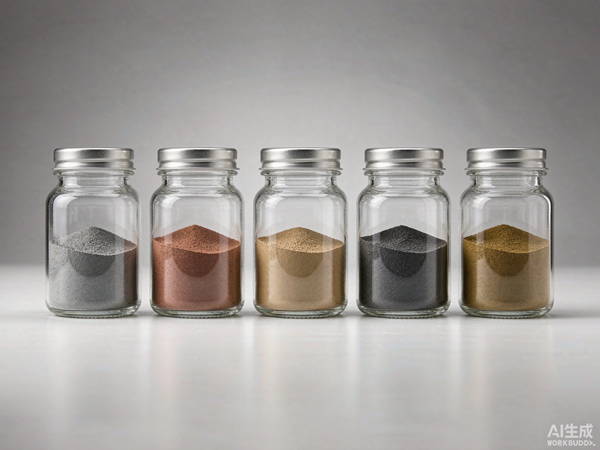
Ya'an Sagwell Technology Co., Ltd. manufactures ultra-fine iron powder and pre-alloyed bond powders for diamond tooling. If sharpness is your target, start with SCF-10 (Fe-Cu-Sn-P; D50 ≈ 24.76 µm, 95–105 HRB, 1150–1250 MPa bending strength) or KIN-03 (Fe-Cu-Co-Sn; D50 4.8–8.2 µm, 99–104 HRB, 1325–1500 MPa, sintered at 800–850 °C). The S2386 sharpness additive and the TUF / SCF-07 ultra-fine iron series round out the range (product grades: SCF-10 / KIN-03 / TUF).
We support toolmakers with trial sample quantities, plus powder selection and formulation adjustment based on your cutting material, machine setup and existing recipe. Start with a small comparison batch, validate on your own saw, then scale.
Send your application details to export@sagwell.com to request samples and formula support.